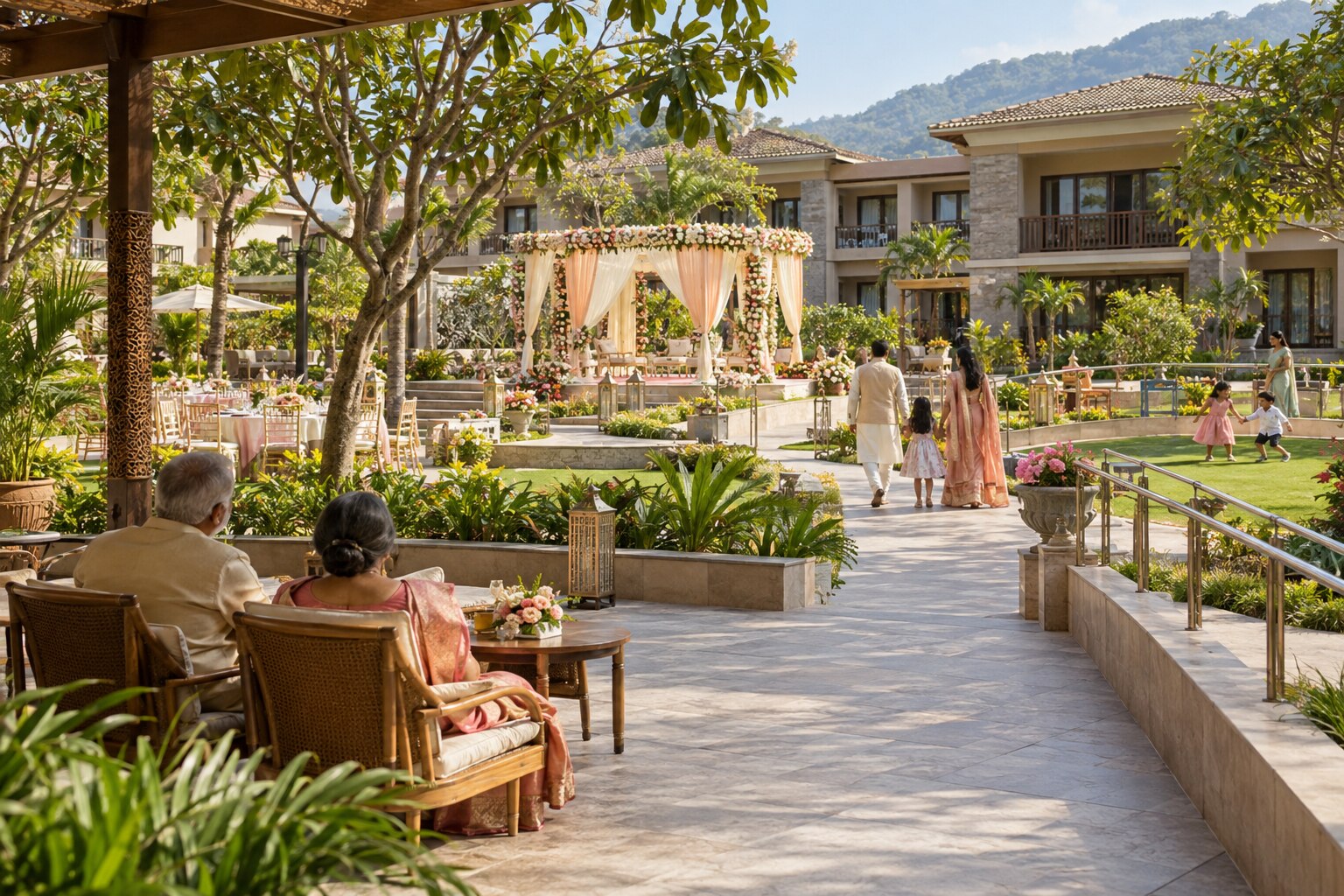
A wedding group may include a baby who needs a quiet room, a teenager who wants independence, parents managing several schedules, and grandparents who cannot manage stairs or long walks. A workable resort plan assigns rooms, routes, meals, supervision, timings, and backup arrangements before guests arrive, so each generation can participate without making another generation uncomfortable.
Key takeaways
- Assign rooms by mobility, sleep, supervision, and privacy needs.
- Test the complete route from parking to ceremony seating before booking.
- Give children supervised spaces, quiet time, shade, and safe activities.
- Put accessibility, meal timing, noise limits, and room locations in writing.
Assign rooms by support needs, not just family surname
Reserve rooms by daily support needs, not by surname or arrival order. For multigenerational wedding accommodation, draw a room map around mobility, sleep, supervision, and privacy. Keep grandparents close to the couple and the shortest route to dining and ceremony spaces, while placing children with the adults responsible for them.
A block that keeps one surname together can still leave an older guest upstairs or put cousins on a sofa in an overcrowded room.
- Grandparents: Request ground-floor rooms for seniors and grandparents near accessible paths, dining areas, and toilets. Confirm that “ground floor” does not require steps at the entrance.
- Parents with infants: Use interconnecting rooms when children need direct supervision but adults need a separate sleeping space. Check cot dimensions, bathroom access, and the permitted occupancy.
- Siblings and cousins: Choose adjoining rooms when families need proximity without sharing an internal doorway. Give teenagers a nearby room rather than placing them with younger children.
- Extended family: Group rooms by relationship and bedtime, leaving a shared sitting area or courtyard for conversation instead of adding extra beds to sleeping rooms.
Do not treat adjoining rooms as accessible rooms. Ask for an accessible bathroom, grab rails, turning space for a wheelchair, and a lift-free route where required. Reserve these room types before the room block release date, and record each guest’s mobility or care need against the room number rather than relying on a family surname.
Test every route from the car to the ceremony
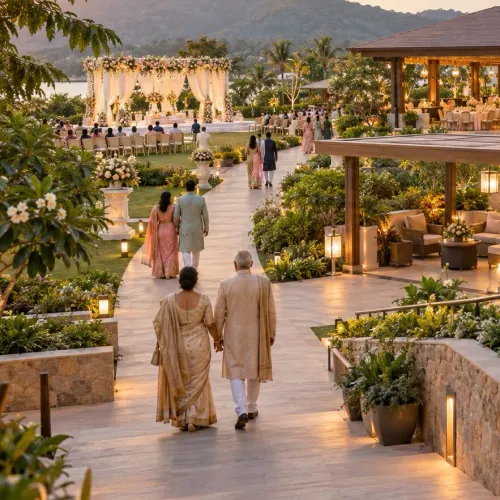
A safe route is continuous step-free access from the drop-off point and parking to reception, bedrooms, dining areas, toilets, and the ceremony lawn or hall. A room labelled accessible proves little if the event space requires stairs or crosses uneven ground.
Confirm that the property functions as a wheelchair-accessible wedding venue, not merely an accessible room.
Walk the complete route with the person who will use it, and check:
- Ramps and handrails, with ramps close to the 1:12 maximum gradient and about 1,200 mm of clear width.
- A 1,500 mm wheelchair turning diameter at doors, lifts, toilets, and tight corners.
- Accessible bathrooms with a level entrance, grab rails, transfer space, and a reachable basin.
- Non-slip paths without loose gravel, grass ruts, raised thresholds, sudden slopes, or exposed cables.
- Short distances, firm seating, shaded waiting points, and a nearby rest room.
Ask where luggage goes, because an older guest should not wait standing while bags are unloaded. Confirm an accessible vehicle, a named contact for delayed arrivals, and a transfer plan for wheelchairs and infant car seats.
For an outdoor ceremony in Nagpur’s pre-monsoon heat, require shade, drinking-water stations, fans or ventilation, and a cool indoor fallback. Set the weather decision deadline in writing; do not leave grandparents deciding at the gate.
Give infants and children a safe plan between ceremonies
Give each child a named plan between ceremonies instead of leaving supervision to relatives. Choose an infant-friendly wedding resort with a quiet, air-conditioned room near the event area, a baby cot and changing space, power for a bottle warmer, and a chair for feeding.
Keep nappies, formula, medicines, spare clothes, and a thermometer in that room.
- Assign two named adults to sign children in and out of supervised children’s activities. Record allergies, emergency contacts, nap times, and who may collect each child.
- Keep the activity room shaded, cool, and away from loudspeakers. Offer puzzles, drawing, board games, books, and a supervised screen period rather than relying on the pool for entertainment.
- Build a rest window before the next ceremony. Children who miss naps become harder to supervise, while infants need quiet feeding and sleep space.
- For outdoor events, provide shade, drinking-water stations, seated breaks, fans or ventilation, and a cool indoor fallback. Set a weather decision deadline before guests dress and travel.
Include pool and water safety in the written plan: use a barrier or controlled entry, confirm a trained lifeguard, and assign an adult who watches the water without using a phone. Never count a flotation device as supervision, and keep toddlers away from decorative ponds and fountains.
Build the programme around sleep, heat, noise, and meals
A multigenerational wedding schedule works when the couple’s key events are not packed into one exhausting day. Hold the ceremony in the cooler morning or late afternoon, serve a seated meal soon afterwards, and protect a two-hour quiet period before evening celebrations. Set a firm music cutoff so older guests and children can sleep.
Use a simple daily rhythm:
- Morning: breakfast, the ceremony, and nearby seated rest areas.
- Midday: lunch followed by an unstructured indoor period, naps, or quiet activities.
- Evening: the reception or sangeet, with children’s food served early and return transport ready before the final performances.
Wedding heat and noise management needs named responsibilities. Provide shaded seating, water stations, fans or ventilation, and a cool indoor fallback; decide by a stated deadline when an outdoor event moves inside. Keep speakers away from bedrooms, and never make older guests cross the dance floor to reach toilets or transport.
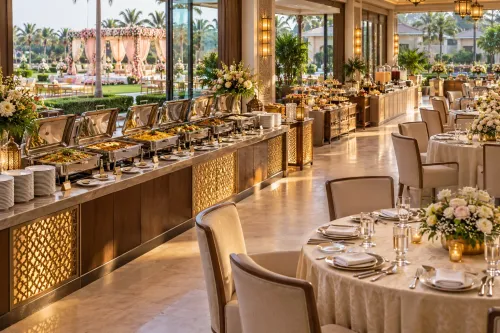
Do not make one buffet serve everyone equally. Offer low-spice and child-friendly meals at a predictable time, plus softer foods for older guests and clearly labelled vegetarian, Jain, diabetic-friendly and allergy-aware food. Ask the kitchen how it prevents cross-contact, not merely which suitable dish appears on the menu.
Reserve separate transport departures for guests leaving early, so no one waits for the couple’s last event.
Turn the family plan into questions for the resort contract
Before paying a deposit, turn every family requirement into a written question. The destination wedding room block and wedding venue contract terms must cover rooms, meals, access, safety, and changes—not just the ceremony date and per-room rate.
1. What room mix is reserved, and until when? Confirm standard, ground-floor, adjoining, interconnecting, and accessible rooms, plus lift access. Adjoining rooms are not accessible rooms; reserve both types before the block release date.
2. What happens if rooms go unused? Ask for the release date, cancellation charges, attrition charges, extra-bed rules, child occupancy limits, and the deadline for changing names or room categories.
3. Can the kitchen meet each meal guarantee? Get written answers on vegetarian, Jain, lower-spice, softer, diabetic-conscious, allergy-aware, and early children’s meals. Ask how staff prevent cross-contact rather than accepting a single “suitable” buffet dish.
4. Is there a continuous step-free route from parking or drop-off to bedrooms, toilets, dining areas, and the ceremony hall or lawn? Use an accessibility checklist for resorts and ask what happens if rain forces an indoor change.
5. What is the emergency planning for wedding guests? Verify ambulance arrangements, first-aid and defibrillator locations, stair-free evacuation, power or weather communication, and event end times.
When comparing Two Brothers Resort Nagpur with another property, put these answers beside the room map and event schedule; a beautiful venue fails if guests cannot reach it safely.
Related products
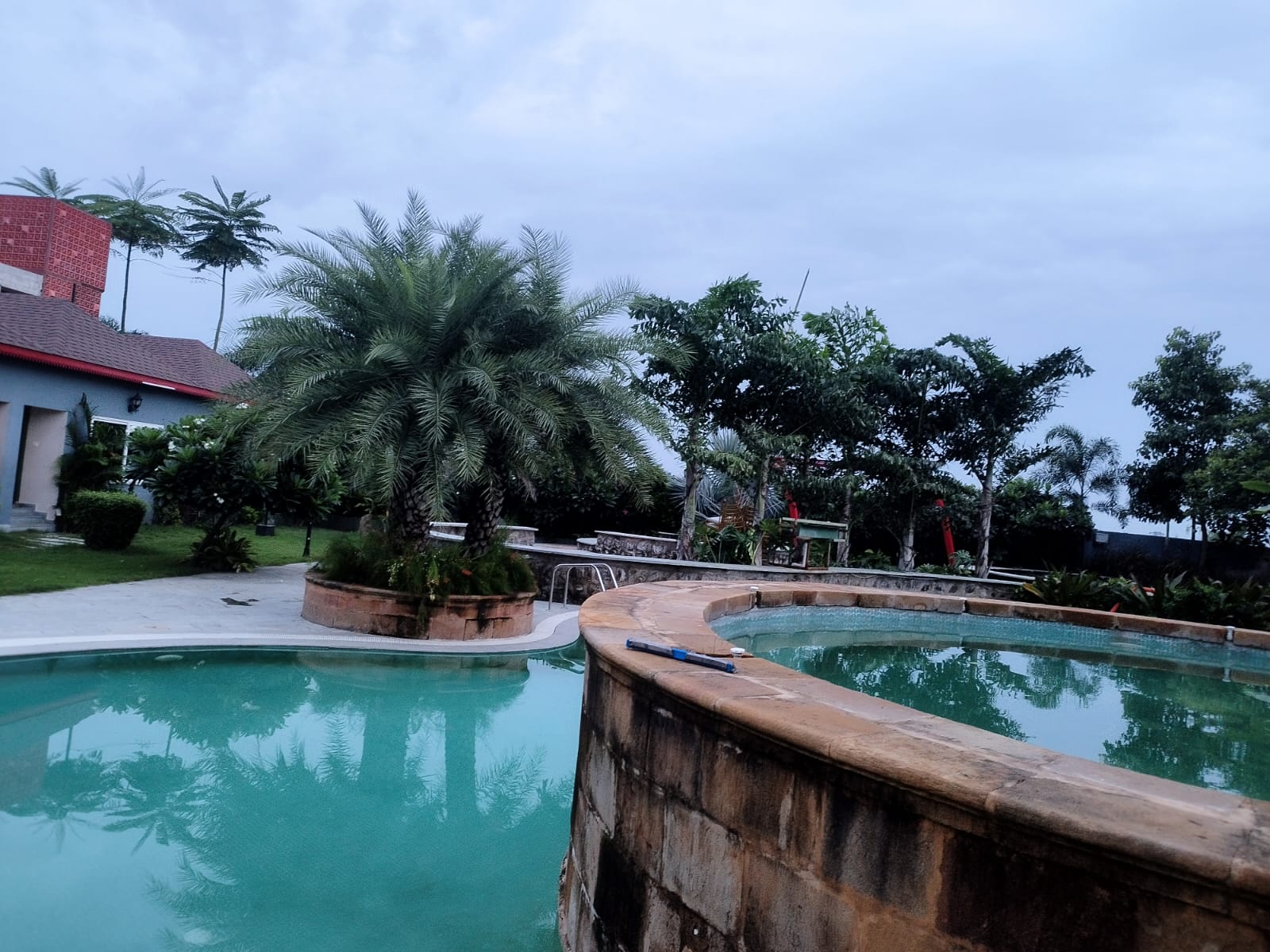 | Family Resort A blend of Natural scenic beauty & facilities like cozy cottages overlooking the lake, pure veg restaurant, fun activities makes our Resort a perfect... View product → |
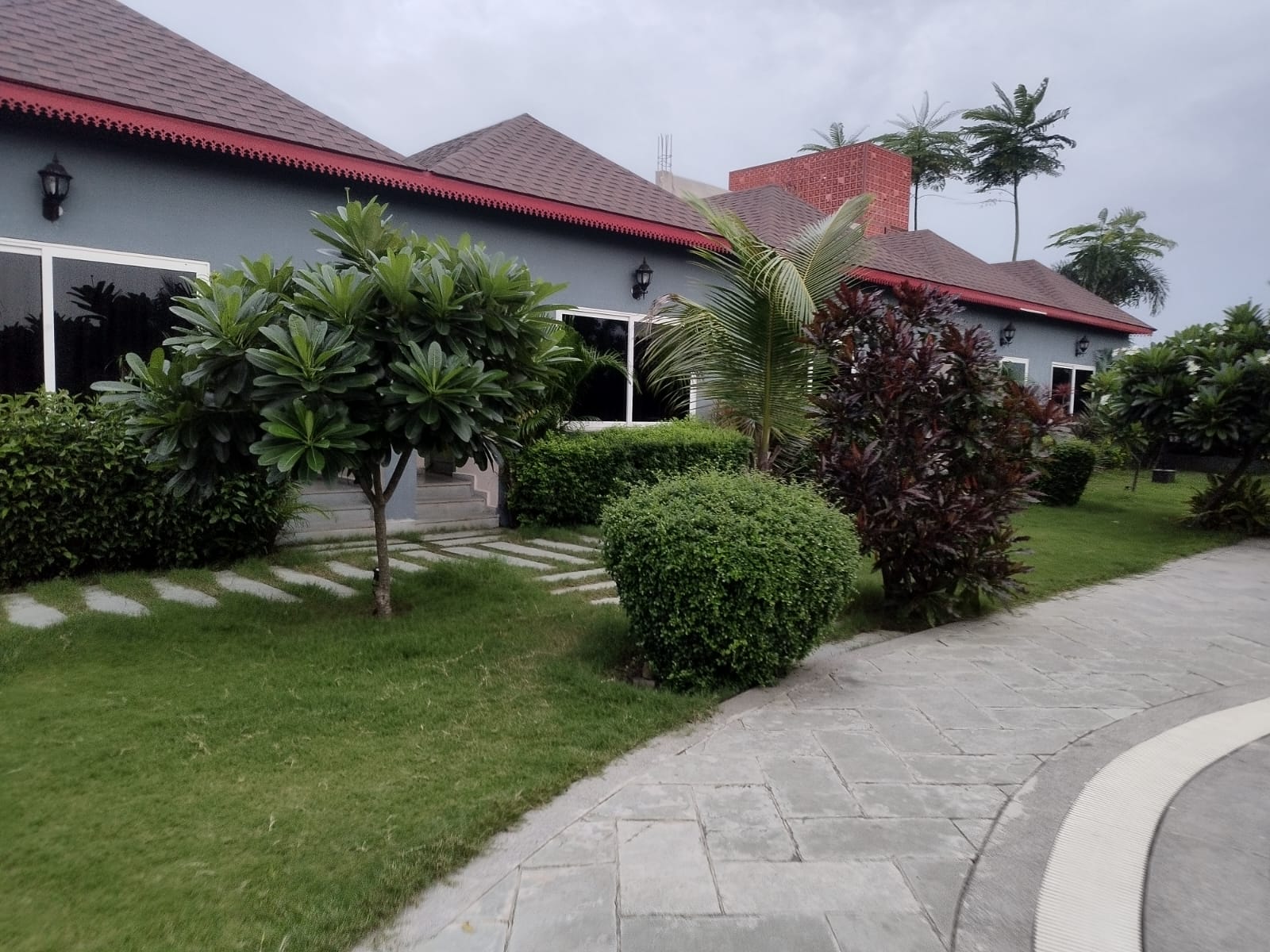 | Destination Wedding Looking for the perfect destination wedding place in Nagpur? Two Brothers Resort is where fairytales come true! Celebrate Love Amidst Nature & Luxury... View product → |
Frequently asked questions
How should rooms be assigned for a multigenerational wedding?
Assign rooms by mobility, sleep, supervision, and privacy needs rather than surname or arrival order. Keep grandparents near dining and ceremony spaces, and place children with their responsible adults.
What route checks should a family wedding resort complete?
Test every route from the car to the room, dining area, toilets, and ceremony. Check ramps, lifts, steps, surface changes, distances, shade, seating, and accessible toilet access.
How can a resort keep infants and children safe between ceremonies?
Create a supervised plan with named adults, a shaded or quiet rest area, safe activities, toilet access, water, and clear handover times. Keep children away from service routes, pools, and traffic.
What should a wedding programme consider for different generations?
Build breaks around sleep, heat, noise, and meals. Offer shorter walking distances, shaded seating, quiet periods, child-friendly food, and an alternative plan for guests who skip late events.
What should families include in the resort contract?
Record room locations, accessible routes, lift availability, ceremony seating, meal timings, child supervision arrangements, quiet hours, cooling or shade provisions, and the process for handling changes.