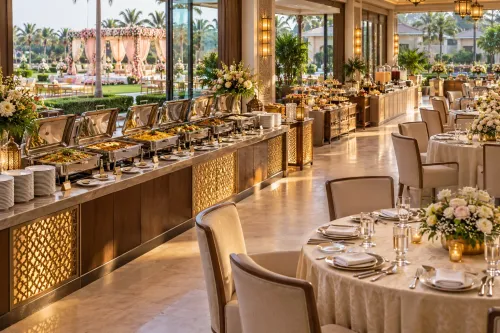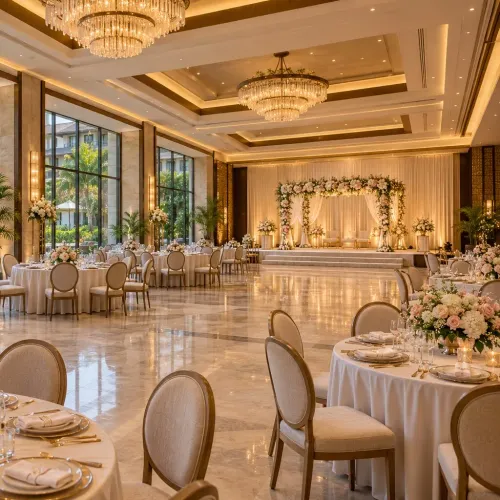
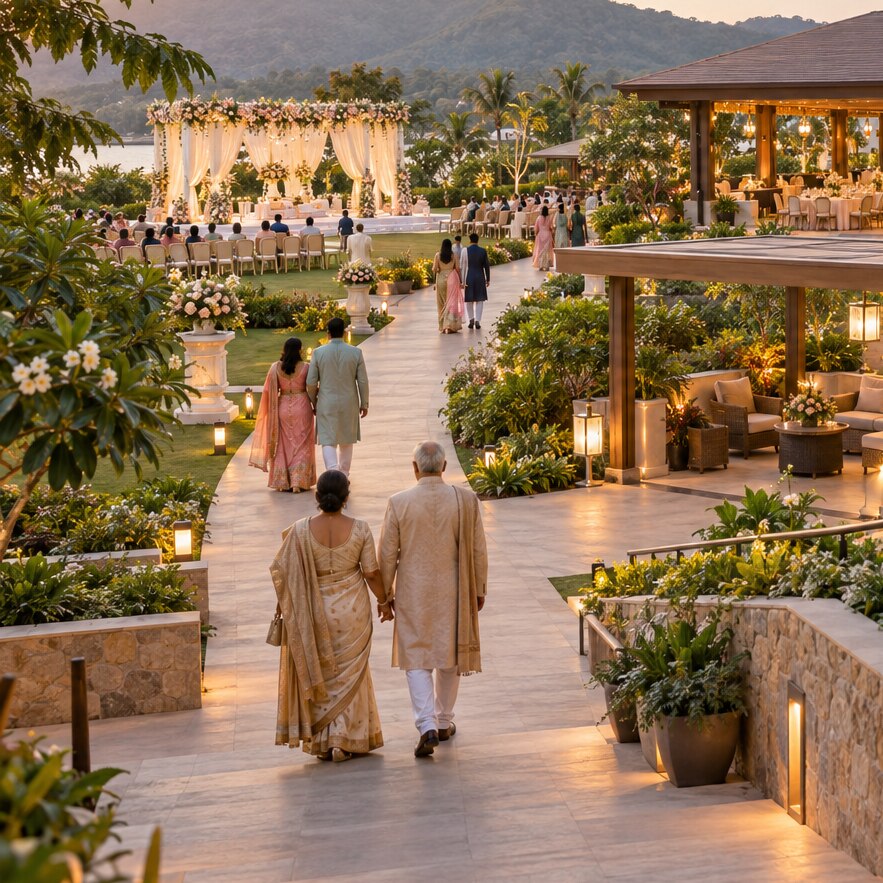
A resort wedding can fall behind because guests, suppliers, vehicles and ceremonies compete for the same paths and time slots. By the end, you will have a practical method for mapping the property, building a timed programme, assigning movement responsibilities and testing whether the venue can support your plan safely.
Key takeaways
- Separate guest, service, supplier and emergency-access zones on one site plan.
- Add travel, seating, photography and reset time between every function.
- Assign one transition lead and publish timings through a single guest communication channel.
- Verify check-in capacity, backup venues, power supply and supplier access before booking.
How do you divide a resort into workable guest and service zones?
Create one site plan that divides the property into separate resort wedding zones, rather than treating it as one event space. Mark each zone clearly:
- Guest rooms
- Vehicle drop-off and parking
- Registration
- Ceremony space
- Dining
- Washrooms
- Children’s area
- Service and loading access
Build the guest movement map around walking times between every zone. Mark shaded paths, steps, lifts, seating, accessible toilets, emergency exits and fire-equipment locations. Add golf-cart stops or shuttle points where a walk is too long for older guests, young children or people carrying luggage.
Draw one continuous accessible wedding route from drop-off to guest rooms, ceremony, dining and toilets. A ramp at the entrance is not enough if the lawn contains loose gravel, steep gradients or steps.
Use firm, non-slip surfaces and place a weather-proof alternative beside every outdoor route, including a rain route with usable drainage and covered waiting space.
Keep kitchen deliveries, waste collection, décor movement and vendor loading on a separate service route. Never send reversing vehicles, guest photography, children and a baraat through the same entrance; a shared gateway quickly becomes a collision and congestion point.
Test the plan under simultaneous occupancy. A lawn that holds the advertised number for one ceremony can become congested when dining, photography, toilet queues and room transfers happen together. Confirm that décor, buffet counters, sofas and barriers do not block fire exits, fire equipment or emergency-vehicle access.
How do you build a minute-by-minute schedule for several wedding functions?
Start with guest-facing times, then work backwards to supplier call times. A written wedding event timeline becomes a minute-by-minute wedding schedule only when every transition has an owner and a recorded walking or shuttle time.
| Guest-facing block | Owner and route | Supplier call time |
|---|---|---|
| Arrival, registration, room allocation, refreshments | Hospitality lead; drop-off to desk to rooms | Registration desk, luggage team and shuttle crew before arrivals |
| Mehendi and haldi | Family coordinators; mehendi near welcome, haldi near rooms or a private washroom | Artists, décor and washroom attendant before guests |
| Sangeet, procession assembly and ceremony seating | Planner; nearby event areas, with procession route marked | Musicians, AV, décor and transport before assembly |
| Wedding rituals, photography and meals | Ritual lead and dining lead; couple’s photography away from guest transfer | Photographer, caterer and serving teams before release |
| Departures | Transport lead; rooms to luggage point to vehicles | Vehicles, luggage crew and desk before checkout wave |
Sequence sangeet, ceremony and reception so guests do not cross the property repeatedly. Separate the couple’s photography slot from the main guest transfer; otherwise family photographs delay ceremony seating and shuttle loading.
Insert a 15–30 minute operational buffer between major blocks. Use it for toilet queues, delayed transport, room changes, wheelchair movement, vendor handover and seating—it is working time, not empty time.
Name one decision-maker who can shorten speeches, photography or entertainment when the programme slips. Release guests to meals by table, family group or seating zone, not in one buffet rush. Add a senior-friendly serving point and a separate children’s option when needed. The mehendi haldi sangeet sequence should protect both movement and recovery time.
How should you manage arrivals, check-in and guest communication?
Build the wedding guest arrival plan around waves, not one check-in time. Divide travellers into road, rail, air, family and late-arrival groups, then assign each a drop-off window, luggage handler and room-allocation contact.
| Group | Drop-off window | Luggage handler | Room-allocation contact |
|---|---|---|---|
| Road | Traffic-based window | Arrival runner | Family-room desk |
| Rail | Train arrival plus buffer | Station shuttle lead | Check-in desk |
| Air | Flight arrival plus buffer | Airport shuttle lead | Accommodation lead |
| Family | Shared family window | Family representative | Family-room desk |
| Late arrival | Open after first function | Hospitality desk | Night contact |
Your resort check-in procedure should provide water, quick registration, luggage tags, room directions and seating before tired travellers join a ritual. Keep the hospitality desk open after the first function begins, so late-arriving wedding guests can settle in without interrupting the ceremony.
Calculate shuttles instead of promising transport. As a first estimate, divide guests by usable vehicle capacity and round up; then add time for loading, return travel, luggage, rain and elderly passengers. Two smaller vehicles can serve several locations better than one large vehicle.
Repeat the same timings in the invitation insert, wedding WhatsApp schedule, welcome desk sheet, room card, venue signs and announcements. Show the meeting point, walking route, shuttle stop, dress requirement, meal time and rain-plan location.
Put one guest coordinator’s phone number on every message, give the emcee the final approved schedule, and never rely on announcements alone.
Who controls each transition, and how do suppliers stay out of the guest flow?
A wedding movement responsibility chart decides who releases each transition; create it before setup, not after guests arrive.
The wedding planner owns the master schedule, the venue manager controls access and emergency routes, family representatives guide relatives and baraat groups, the transport lead runs vehicles, the hospitality desk handles check-in and room questions, and the emcee announces approved changes only.
1. Write triggers beside each name: “open dining when ceremony release is confirmed” and “hold the shuttle when the procession occupies the driveway.” Include arrival, room check-in, procession assembly, ceremony seating, meal opening, photography and departure.
2. Issue a supplier access schedule for decorators, caterers, photographers, musicians, rental crews and AV technicians. Give each a separate arrival window and loading route; this protects back-of-house event logistics from guest movement.
3. Keep cases, cables, buffet equipment, flower carts and waste bins outside guest paths and fire exits. Ask for the approved occupancy and emergency-egress plan for every function area, not just its square-footage figure. Recheck it after mandap structures, DJ equipment, sofas, barriers and buffet counters are installed.
4. Put the monsoon wedding contingency in writing: set a rain decision time and name the indoor switch, guest route, seating, power, toilets, drainage, wet-footwear handling and equipment protection.
5. In hot months, test the procession route at its actual time. Provide shade, water and waiting seats.
6. Confirm local permission for amplified sound. Loudspeakers are generally restricted from 10 p.m. to 6 a.m., subject to limited exceptions under the Noise Pollution Rules.
What should you verify with a resort before confirming the wedding plan?
Do not confirm a resort until its staff can test the plan as a live movement exercise, not merely point to a lawn and quote its wedding venue capacity. Use this resort wedding venue checklist:
1. Ask the venue to walk through arrival, procession, ceremony release, dinner opening and departure at their exact planned times. Record route lengths, waiting points, named staff and the number and capacity of golf carts or shuttle vehicles.
2. Request the approved occupancy and emergency egress plan for every area after mandap structures, sofas, buffet counters, DJ equipment and barriers are installed. Mark fire equipment, unobstructed emergency-vehicle access, accessible routes, accessible toilets, shaded waiting areas and a weather-proof indoor fallback.
3. Obtain a written service route for kitchen deliveries, waste, décor and equipment. Add supplier access windows for caterers, decorators, musicians, photographers and AV crews that finish before guest arrival; reversing vehicles and baraat groups must not share an entrance.
4. Check room locations against speakers and neighbouring premises. Ask who controls volume, what local permission applies, how sound will be monitored, and when music must stop near guest rooms.
5. If you are comparing Two Brothers Resort Nagpur with other venues near Nagpur, ask for written timings, route lengths, vehicle arrangements, rain procedures and named on-site contacts. Attractive grounds cannot reveal who moves each guest group, vehicle and supplier at every transition.
Related product
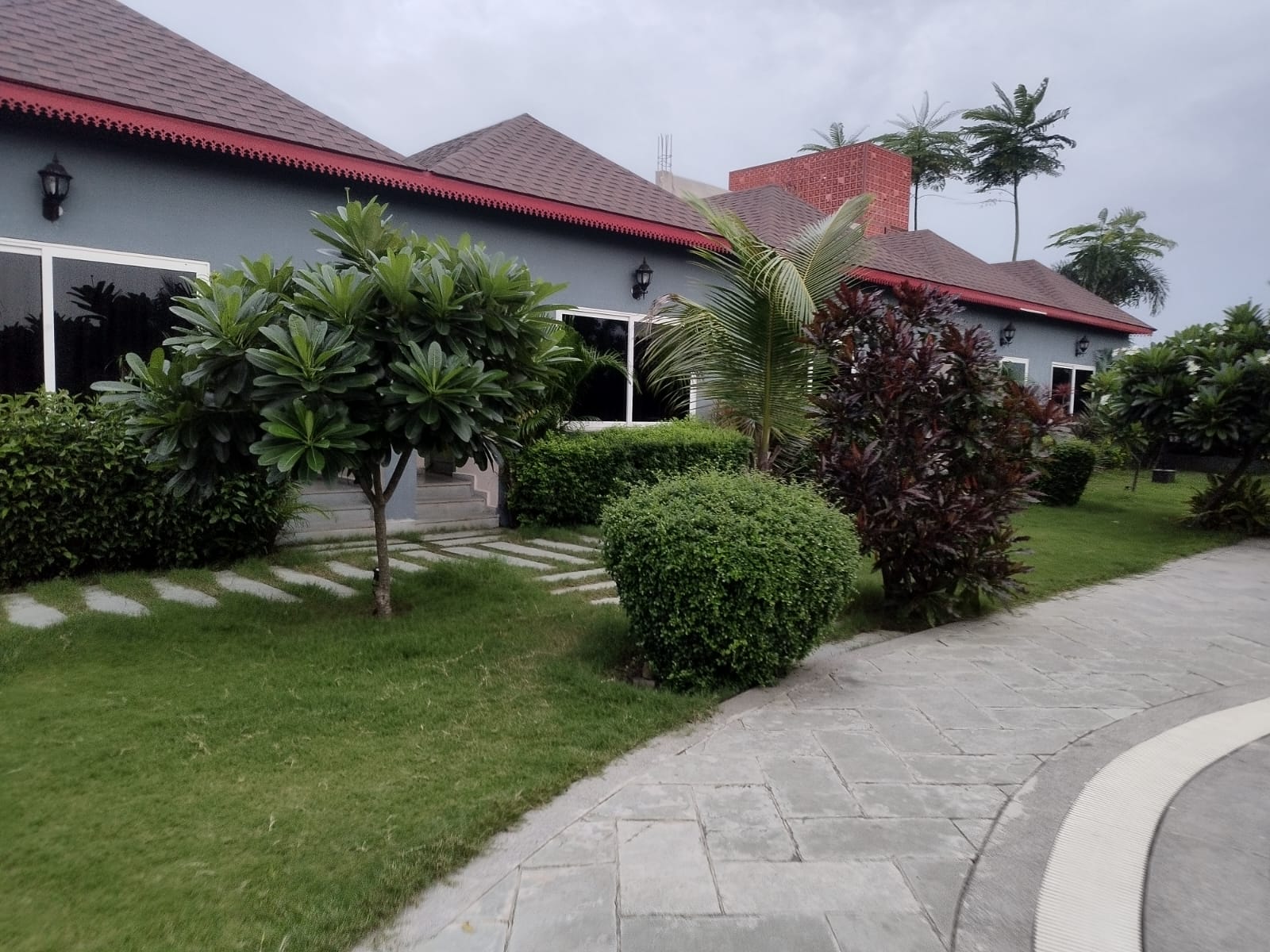 | Destination Wedding Looking for the perfect destination wedding place in Nagpur? Two Brothers Resort is where fairytales come true! Celebrate Love Amidst Nature & Luxury... View product → |
Frequently asked questions
How do you divide a resort into workable guest and service zones?
Create one site plan with separate guest, service, supplier, accommodation, parking and emergency-access zones. Mark routes, entrances, toilets and restricted areas clearly.
How do you build a minute-by-minute schedule for several wedding functions?
Schedule guest arrivals, seating, travel, ceremonies, meals, photography, venue resets and departures as separate time blocks. Add buffer time between functions.
How should you manage arrivals, check-in and guest communication?
Separate wedding check-in from reception, assign arrival staff and share one current itinerary with maps, room details, shuttle times and a contact number.
Who controls each transition, and how do suppliers stay out of the guest flow?
Name one transition lead for each movement and give suppliers fixed loading times, service entrances, holding areas and routes away from guests.
What should you verify with a resort before confirming the wedding plan?
Verify venue capacities, distances, check-in arrangements, backup spaces, power, sound limits, parking, supplier access, weather plans and emergency routes.